
Calculator comparison
GetBirthChart vs Cafe Astrology: Birth Chart Calculator Comparison
For the same synthetic Tropical / Placidus fixture, GetBirthChart and Cafe Astrology produced closely matching planets, angles and house cusps: the tested shared values differed by 0–1′. GetBirthChart is the clearer fit for a calculation-first surface and explicit unknown-time boundary; Cafe Astrology is the stronger fit for a traditional, text-heavy report. Neither result supports a universal winner.
Editorial standards overseen by Luis PhamMethodology
Publisher disclosure · tested August 25, 2026
This comparison is published by GetBirthChart. We tested each calculator with the same synthetic birth data and separated observed results from provider-documented claims. The fixture is not a real person’s birth data, and the page is not an independent certification of either calculator.
Quick verdict
Choose GetBirthChart if you want a focused result that separates calculated chart facts from interpretation, discloses the calculation engine and handles missing birth time conservatively. Choose Cafe Astrology if you prefer a traditional report with denser explanatory text and a long-established report format.
On the calculation fixture, both tools were close. The meaningful differences were output scope, unknown-time presentation, additional chart points, advertising and report style—not a demonstrated accuracy gap.
| Use case | Better fit in this test | Why |
|---|---|---|
| Transparent calculations and unknown-time handling | GetBirthChart | Explicit limitations, engine/version disclosure and omitted time-dependent facts |
| Traditional, text-heavy astrology report | Cafe Astrology | More extensive prose and report-style interpretation |
| Same-data calculation cross-check | Either | Shared planets, angles and cusps differed by 0–1′ |
Side-by-side feature comparison
The table records what was observed in the supplied test run or documented by the provider. “Not shown” means it was not present in that tested output; it does not mean the service can never provide the feature elsewhere.
| Criterion | GetBirthChart | Cafe Astrology |
|---|---|---|
| Tropical zodiac / Placidus houses | Available in tested workflow | Available in tested workflow |
| Shared planets, ASC and MC | Displayed | Displayed |
| True North Node labeling | True North Node in current profile/reference | True North Node shown in interpretation; table says N Node |
| Chiron | Shown as an Additional chart point | Not shown in tested free technical table |
| Unknown-time workflow | Explicit checkbox and warning | Explicit Unknown Time / no-houses option |
| Houses when time is unknown | Omitted | Omitted |
| Technical calculation details | Calculation engine and provenance disclosed | Engine not disclosed on tested free result |
| Interpretation depth | Guided interpretation with a calculation-first surface | Traditional, text-heavy report |
| Ads in tested result | None observed | Multiple display ads observed |
| Free chart account requirement | No | No |
| Sharing | Private by default; sharing is opt-in | Shareable setting was opt-in in tested workflow |
| Privacy disclosure | Provider policy documents chart-data handling | Provider terms document profile storage, cookies and advertising |
Test methodology
The shared fixture is January 15, 1990, 12:00 PM, New York City, New York, United States, EST / UTC−05:00, Tropical zodiac and Placidus houses. It is synthetic. We compared displayed longitude values, signs, retrograde flags, angles, house cusps, supported points and the separate unknown-time workflows.
Settings were matched before any value was compared, and a 0–1′ gap is treated as consistent with display rounding rather than proof that the unrounded engine values are identical. The full fixture, evidence labels and difference thresholds live in the comparison methodology; GetBirthChart's own boundaries are in the Calculation Reference, Methodology and Corrections Policy.
| Field | Value |
|---|---|
| Fixture ID | GBC-COMP-001 |
| Date and time | January 15, 1990 · 12:00 PM |
| Location | New York City, New York, United States |
| Time zone | EST / UTC−05:00 |
| Zodiac / houses | Tropical · Placidus |
| Data status | Synthetic only; no personal chart data |
| Rounding rule | 0–1′ differences are reported as rounding-consistent |
Exact-time calculation comparison
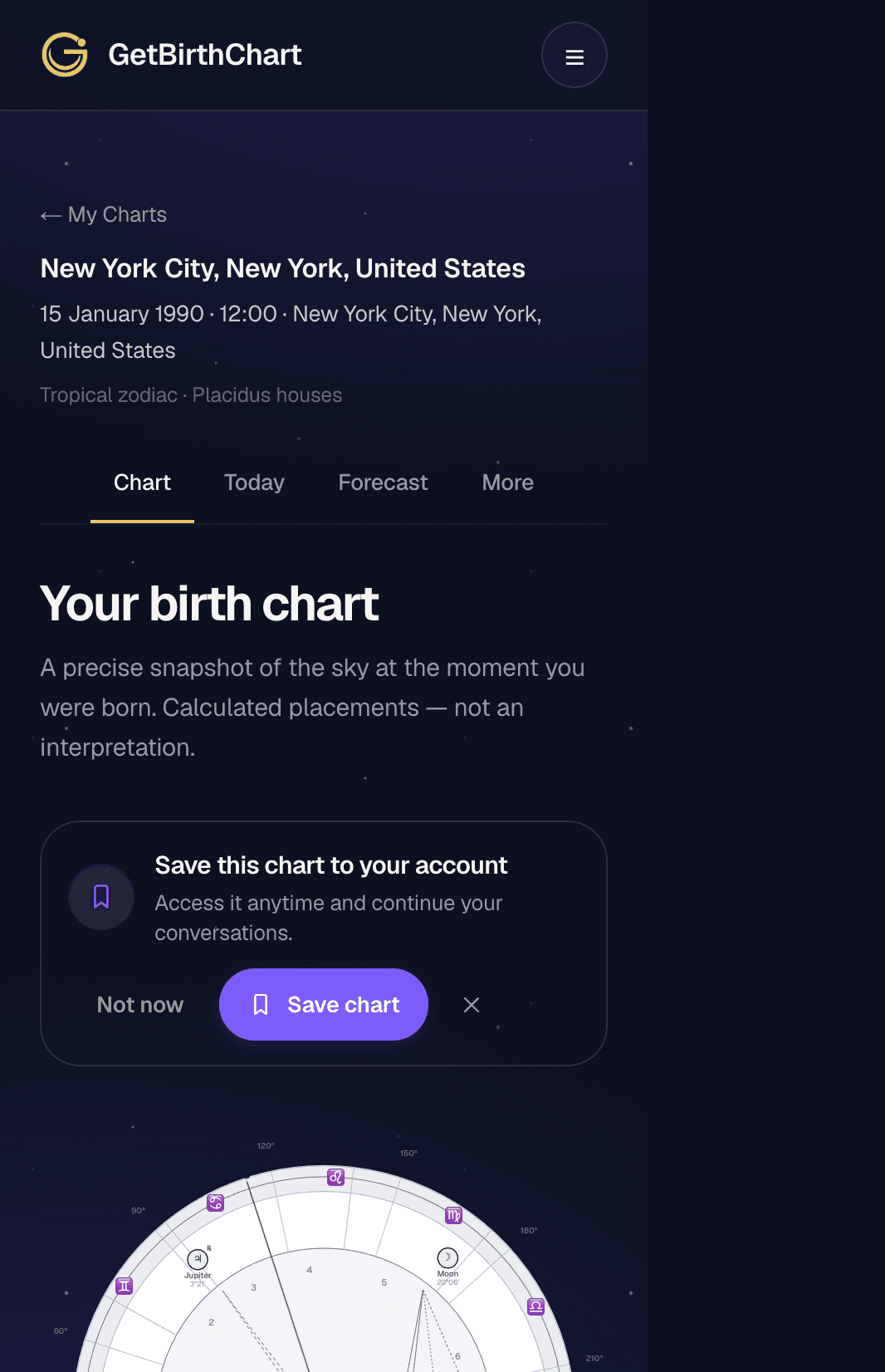
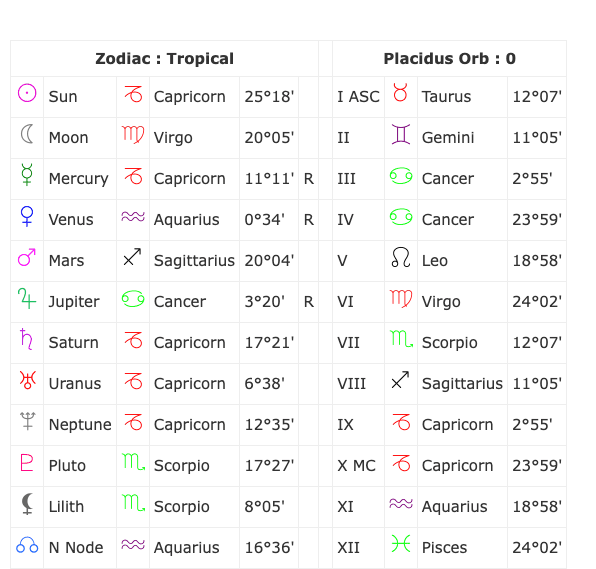
The shared planets, Ascendant, Midheaven and all twelve Placidus cusps were within 0–1′ in the supplied result tables. That is the main calculation finding: the two tested outputs are closely aligned when the visible settings are matched.
A one-arcminute difference can come from rounding a nearby underlying longitude. It should not be inflated into an inaccuracy claim. These results also do not establish a universal ground-truth ranking across dates, coordinates or settings.
| Point | GetBirthChart | Cafe Astrology | Difference / interpretation |
|---|---|---|---|
| Sun | Capricorn 25°17′ | Capricorn 25°18′ | 1′; rounding-consistent |
| Moon | Virgo 20°06′ | Virgo 20°05′ | 1′; rounding-consistent |
| Mercury | Capricorn 11°12′ R | Capricorn 11°11′ R | 1′; rounding-consistent |
| Venus | Aquarius 0°34′ R | Aquarius 0°34′ R | 0′ |
| Mars | Sagittarius 20°03′ | Sagittarius 20°04′ | 1′; rounding-consistent |
| Jupiter | Cancer 3°21′ R | Cancer 3°20′ R | 1′; rounding-consistent |
| ASC | Taurus 12°06′ | Taurus 12°07′ | 1′; rounding-consistent |
| MC | Capricorn 24°00′ | Capricorn 23°59′ | 1′; rounding-consistent |
| Placidus house cusps | Recorded | Recorded | All 0–1′ |
True North Node and Chiron
The current result surface displays True North Node and Chiron under Additional chart points, not as planets. Earlier evidence was superseded after this display update and is not used for the current conclusion.
For this fixture, GetBirthChart shows True North Node Aquarius 16°35′ and Chiron Cancer 12°51′ R, with houses 10 and 3 when the birth time is known. Cafe Astrology showed True North Node Aquarius 16°36′ and did not show Chiron in the tested free technical table. The Node difference is one arcminute and is consistent with rounding; it is not a material disagreement. GetBirthChart’s current public profile uses True North Node; it does not offer a public Mean/True toggle. Cafe’s North Node reference (opens in a new tab) documents the True North Node convention used by its tables and calculator.
| Point | GetBirthChart | Cafe Astrology | Evidence reading |
|---|---|---|---|
| True North Node | Aquarius 16°35′ | Aquarius 16°36′ | True Node values agree within 1′ |
| Chiron | Cancer 12°51′ R | Not shown in tested free technical table | Feature/output difference |
| Lilith | Not shown | Scorpio 8°05′ | Feature/output difference |
Unknown birth time comparison
Both tested workflows omit the Ascendant and houses when birth time is unknown. GetBirthChart makes the boundary prominent: it labels the time as unknown, marks Rising unavailable and omits house-dependent facts rather than presenting an assumed clock time as the birth time.
Cafe Astrology also provides an Unknown Time / no-houses workflow. Its instructions and captured report retain planetary degrees using the time field in the run, while warning that the Moon and Ascendant can be uncertain. That is a different presentation policy, not evidence that Cafe Astrology’s calculation engine is wrong. For a general explanation of what can and cannot be known, read Birth chart without an exact birth time.
| Behavior | GetBirthChart | Cafe Astrology |
|---|---|---|
| Workflow | I do not know my exact birth time | Unknown Time / no-houses checkbox |
| ASC, MC and houses | Omitted; Rising Unavailable | Omitted |
| Planet degrees | Conservative sign-level result; degree policy is explicit | Degrees remain in the generated report |
| Moon uncertainty | Handled through the unknown-time limitation | Report warns the Moon may change sign during the date |
| Aspects | Planet aspects remain; angle-dependent facts are omitted | Planet aspects remain; angle/node output is reduced |
| Pluto motion in the captured run | Direct; no retrograde label | Not used as a comparison claim |
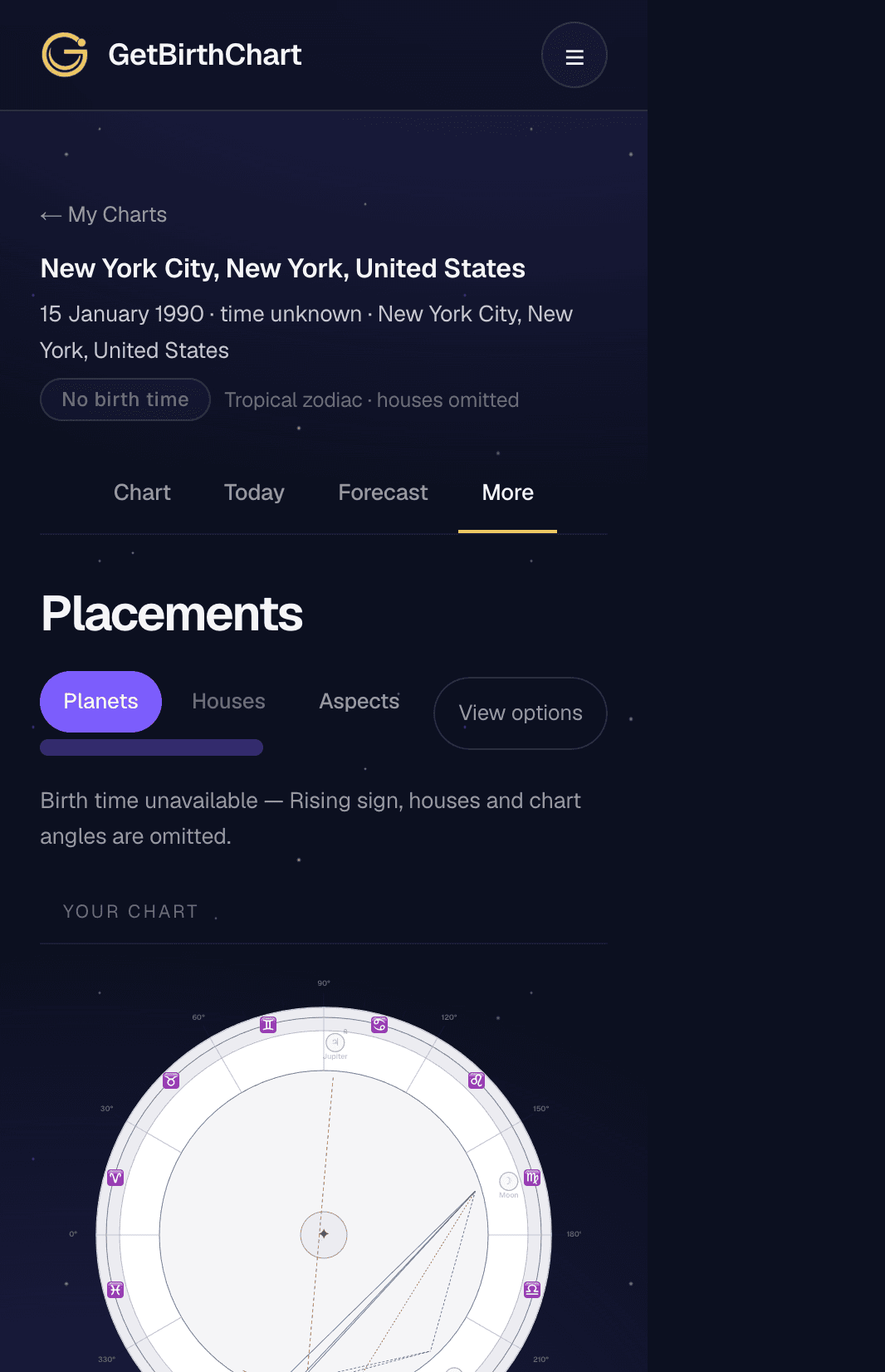
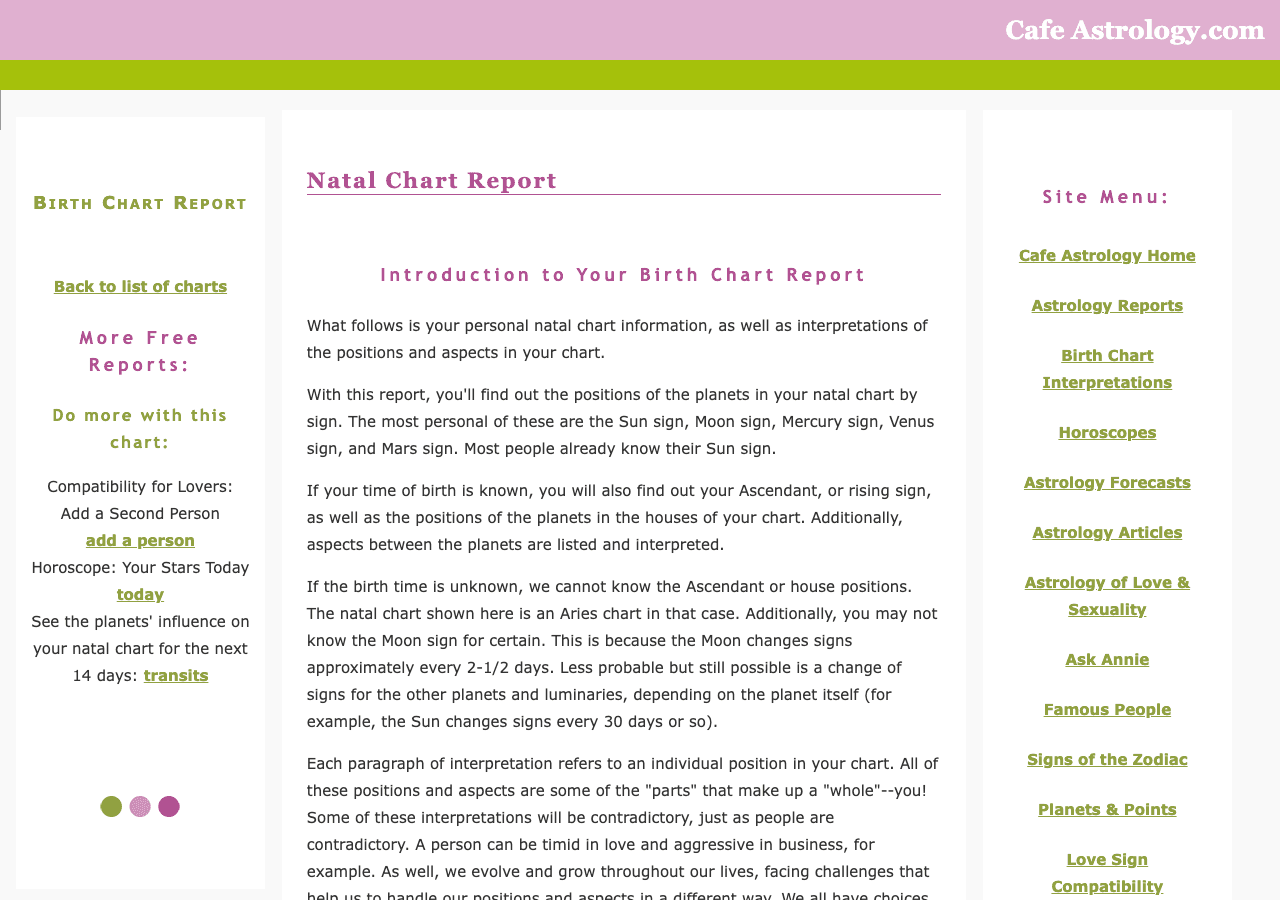
Chart readability and interpretation depth
GetBirthChart presents a cleaner, calculation-first result: the wheel, placement facts, house context and aspect details are separate from the later interpretive layer. Its current placements view includes True North Node and Chiron as additional points, so the semantic distinction remains visible while still allowing them to be selected and inspected.
Cafe Astrology offers a more traditional report experience with extensive prose and a technical table. That density can be useful when a reader wants a long reading in one document, while a reader who wants to inspect one calculated fact at a time may prefer the more guided GetBirthChart surface.
Privacy, ads, sharing and accounts
In the supplied desktop test, no ads were observed on the GetBirthChart result and multiple display ads appeared in the Cafe Astrology experience. Both calculators allowed a free chart without an account in the tested workflow. GetBirthChart documents private-by-default charts with opt-in sharing; Cafe’s form showed shareable settings off by default and described profile-number storage and cookies. These are observed/provider-documented behaviors, not claims about every page or future deployment.
GetBirthChart’s privacy policy also discloses that Ask features may use third-party AI providers; the deterministic chart calculation remains separate from that interpretation feature. Cafe’s terms and privacy page (opens in a new tab) documents advertising and chart storage. Readers with a specific privacy requirement should review the current policies directly.
Who should choose GetBirthChart?
GetBirthChart is a good fit for readers who want a cleaner interface, explicit calculation provenance, a current True North Node label, Chiron as an additional chart point and a cautious unknown-time workflow. It is also useful when the reader wants to move from deterministic chart facts into interpretation without treating the interpretive layer as the calculator.
Who should choose Cafe Astrology?
Cafe Astrology is a good fit for readers who prefer a conventional, text-heavy report, want a long-form interpretation format and are comfortable with an ad-supported experience. Its tested True North Node output was close to GetBirthChart’s displayed value, and its unknown-time workflow includes warnings about the limits of the result.
Limitations of this comparison
This is one synthetic fixture, one captured test date and a limited set of workflows. It does not test every date, location, house system, provider report, account path, browser, ad state or mobile screen. It is not a universal accuracy ranking, and Cafe Astrology’s report will not be the right format for every reader.
The comparison article intentionally does not use the mislabeled `gbc-exact-result-desktop.png` screenshot, which depicts Astro-Charts rather than GetBirthChart. The current result implementation and updated test data are the source of truth for the two additional points.
Final verdict
For transparent calculations and cleaner unknown-time handling, GetBirthChart is the better fit in this test. For a traditional, text-heavy astrology report, Cafe Astrology is the better fit. The underlying shared calculations were close enough that the choice should be based on output style, disclosure and workflow—not a claimed universal accuracy winner.
Evidence and update notes
The evidence was captured and reviewed August 25, 2026 using the supplied CSV tables, raw evidence, test report and screenshots. The current GetBirthChart result after the Node/Chiron display update is the source of truth for those two points; the older “not displayed” rows are retained only as an audit note. Cafe’s current public sources include its calculator (opens in a new tab), True Node reference (opens in a new tab) and unknown-time guidance (opens in a new tab). Corrections should follow the Corrections Policy.
Common questions
Is GetBirthChart more accurate than Cafe Astrology?
This test did not establish an overall accuracy winner. The shared planets, angles and Placidus cusps differed by 0–1′, which is consistent with display rounding for this fixture.
Why can birth chart calculators differ by one arcminute?
The underlying longitude can be close while each result rounds the displayed degree and minute differently. A 0–1′ display difference is not, by itself, evidence of a material calculation error.
Do both calculators use the True North Node?
The current GetBirthChart profile documents True North Node. Cafe Astrology labels True North Node in the tested interpretation and its official reference materials. Their displayed values were Aquarius 16°35′ and 16°36′.
Which calculator is better without an exact birth time?
Both tested workflows omit houses and angles. GetBirthChart makes the limitation especially explicit and labels Rising unavailable; Cafe Astrology also warns about missing time and Moon uncertainty while retaining degrees in its generated report.
Does Cafe Astrology show Chiron?
Chiron was not shown in the tested free technical table. GetBirthChart now shows Chiron as an Additional chart point, with Cancer 12°51′ R for this fixture.
Can I compare the same chart on both calculators?
Yes. Match the local date, time, location, Tropical zodiac, Placidus houses and node convention, then compare the displayed longitudes with rounding in mind.
Calculate your chart with the same settings
Run the same Tropical / Placidus fixture—or use your own birth details—and inspect the calculation facts before interpretation.
Calculate your chart